


Collagen is one of the most abundant proteins in the human body and, at the same time, one of the ingredients generating the greatest interest in cosmetic development and dermatological research. Its use in cosmetics has become well-established due to its structural role in the skin, its involvement in skin aging processes, and the potential offered by biotechnological production. All of this makes it a key element in the development of effective and sustainable products.
What is collagen?
Collagen is a fundamental protein for the structure of the human body, especially in tissues such as skin, bones, tendons, and blood vessels. It belongs to a broad family, with at least 28 types identified to date, which differ in their location, function, and structural organization. Although many types contain triple-helix regions, this feature is not universal: some form long, resistant fibers, while others are associated with cell membranes or interact with other extracellular matrix molecules.
This structural diversity allows collagen to fulfill a wide range of functions: from providing support and mechanical strength to regulating processes such as cell adhesion, wound healing, and the integrity of the connections between skin layers. Its presence is essential for maintaining the skin’s firmness, elasticity, and structural function over time, making it a key target in cosmetic formulations aimed at protecting, repairing, or preventing skin aging.
Collagen in the Skin
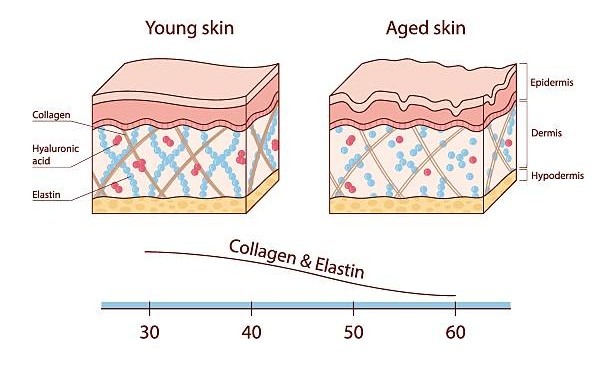
In the skin, collagen is one of the most abundant components of the extracellular matrix, especially in the dermis, where it forms a three-dimensional network that provides structure, firmness, and tensile strength. In addition to its mechanical function, collagen plays a role in organizing the cellular environment, promoting communication between fibroblasts and the matrix, and contributing to water balance and tissue regeneration.
Among the many types of collagen identified, some play an especially important role in the skin, both due to their abundance and their specific function:
- Type I collagen: the most abundant, found in the dermis and responsible for its strength and firmness.
- Type III collagen: associated with the elasticity and regenerative capacity of dermal tissue.
- Type XVII collagen: located at the dermoepidermal junction, it serves an anchoring function between the skin layers, contributing to structural cohesion.
The organization and balance among these types are crucial for the quality and functionality of the skin at any age.
Collagen and Hair Health
Although its role in the skin is well studied, collagen also has important implications for hair health. Various types of collagen are present in the hair follicle and the surrounding connective tissue, where they help maintain the structural and functional integrity of this biological unit.
During the anagen phase (active growth), collagen is involved in the formation of the dermal sheath and the stability of the hair bulb. Additionally, remodeling of type XVII collagen—expressed in the follicle’s basement membrane—has been linked to follicular cycle renewal and anchoring of the hair shaft.
The age-related decline in collagen also affects the microarchitecture of the scalp, which can lead to reduced hair density and vitality. For this reason, collagen has been incorporated into hair care formulations with the aim of improving fiber strength, reinforcing follicle structure, and maintaining an optimal extracellular environment for growth.
Collagen Degradation with Age
Starting around the ages of 25 to 30, collagen synthesis by fibroblasts begins to progressively decline. At the same time, the activity of matrix metalloproteinases (MMPs)—enzymes that degrade the extracellular matrix—increases.
This results in a loss of collagen density, fiber disorganization, and a reduction in dermal thickness. As a consequence, the skin loses firmness, becomes thinner, drier, and more prone to wrinkle formation. This process is closely linked to oxidative stress, glycation, and chronic sun exposure, all of which accelerate the fragmentation of type I and III collagen.
Use of Collagen in Topical Cosmetics: Functions and Limitations
The use of collagen in cosmetics has traditionally been established due to its film-forming and moisturizing properties. In its native or partially hydrolyzed form, it can create a film over the skin that reduces transepidermal water loss, visibly improving hydration and skin smoothness.
In addition, some fragments derived from collagen (low molecular weight peptides) act as biochemical signals for fibroblasts, indirectly stimulating the synthesis of new endogenous collagen. This signaling action has become a common strategy in the development of functional cosmetic actives with firming and anti-aging effects.
However, due to its molecular size, intact collagen has limited ability to penetrate beyond the outermost layers of the stratum corneum. For this reason, its cosmetic action is mostly restricted to surface-level functions such as hydration and protection—except in the case of derived peptides with greater bioavailability.
Collagen Sourcing: The Key Role of Biotechnology
Historically, collagen used in cosmetics has been obtained through acid or enzymatic hydrolysis of animal tissues such as pig skin, bovine tendons, or fish skin. Although these sources have been widely used, they present limitations in terms of standardization, microbiological safety, traceability, and ethical or religious acceptance.
Current demands for safety, sustainability, and innovation have driven a transformation in the use of collagen in cosmetics, particularly regarding its source and functionality.
ChatGPT Plus
Biotechnology offers a highly promising alternative. Through genetic engineering techniques, it is possible to produce collagen or collagen-like proteins in recombinant systems such as bacteria, yeast, or plant cells.
This approach allows for:
- Controlling the sequence and structure of collagen, optimizing it to enhance its cosmetic functionality.
- Eliminating animal-derived contaminants and reducing the risk of immune reactions.
- Increasing product reproducibility by avoiding the variations inherent to animal tissues.
- Reducing the ecological footprint of the process through sustainable and scalable cultivation platforms.
- Adapting the collagen profile to specific needs (e.g., human recombinant type I collagen for anti-aging formulations).
In addition, biotechnology enables the production of vegan or “human-like” collagen, supporting the development of products aimed at consumers with ethical concerns, safety considerations, or sensitivity to animal-derived ingredients. It also allows for specific modifications to enhance stability, bioactivity, or compatibility with different skin types.
Conclusion
The use of collagen in cosmetics goes far beyond its structural role. It is a dynamic component that maintains skin integrity, participates in cell communication, and directly influences the appearance of the skin.
As we age, preserving the collagen network or promoting its renewal becomes a key objective in cosmetic development. In this context, biotechnology represents a turning point—not only as a cleaner and more controlled method of production, but also as a tool for designing new forms of collagen with optimized properties. Innovation in topical collagen-based formulations is moving toward more effective, sustainable solutions that are tailored to today’s skin care challenges.
At Ismael Quesada Personal Care, we offer biotech-derived collagen designed to ensure efficacy, stability, and compatibility in demanding cosmetic formulations.
If you’re developing products aimed at improving firmness, hydration, or scalp health, get in touch with us to request technical information, samples, and commercial terms.